
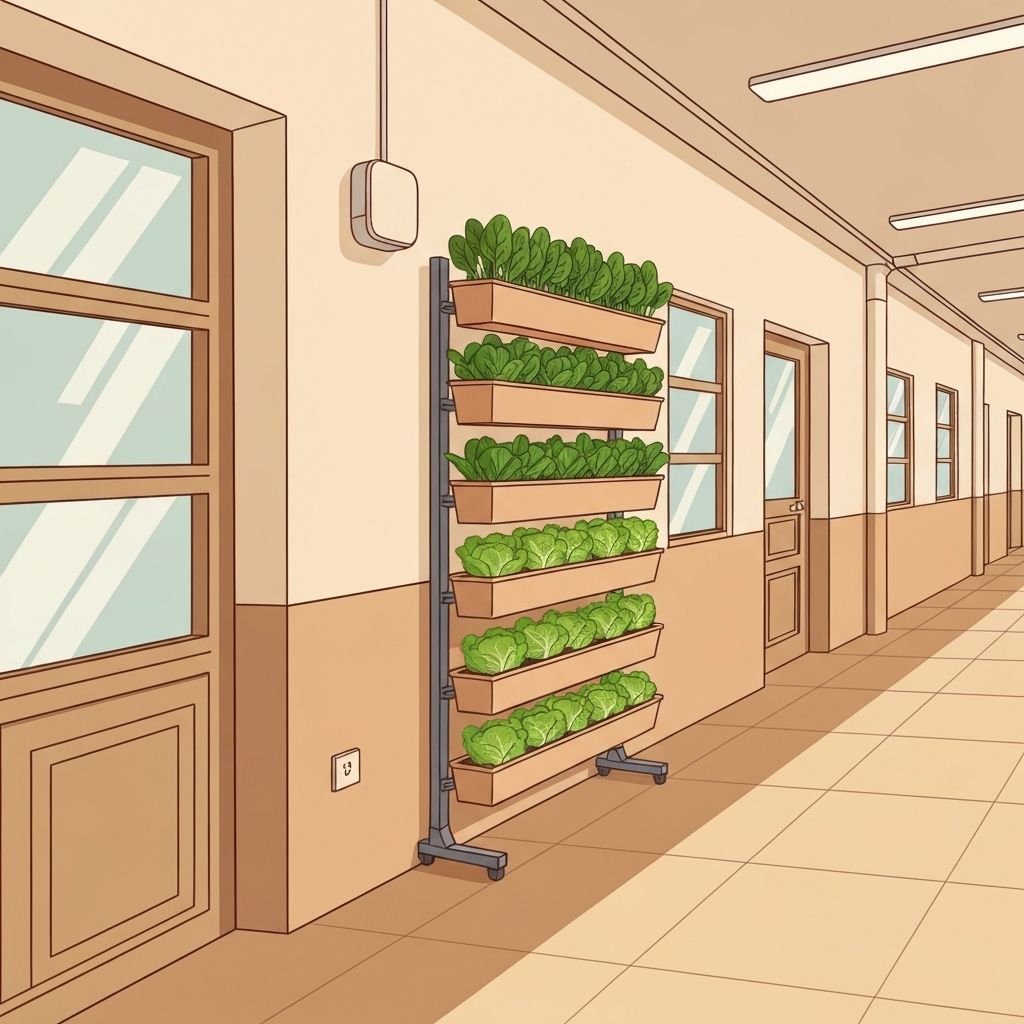
The Let’s Grow system

Top up the water. Harvest the food.

Pilot package design

The intended offer combines a growing package configured from existing marketplace products, ready-to-place seedling delivery and Plant Kakis—so households can begin without shopping for equipment or handling loose soil.

Illustrated modular planter installed beside the wall of an apartment corridor
Configuration concept · final marketplace products remain in pilot validation
16selected
components

The equipment’s role

Curated and configured—not reinvented.

A planned single delivery of existing marketplace planters, tools and supplies, selected and configured for the household’s corridor or balcony so no additional equipment purchase should be needed to begin.

The planter package is an enabling layer, not a newly invented planter. The prototype uses existing products selected for fit, safety, maintainability and how well they work together in the customer’s actual space.

01

Selected to work togetherExisting planters and tools are assessed as a package, rather than left for the customer to research and combine.

02

Configured for the homeThe modular arrangement is planned around the household’s actual corridor or balcony and its site constraints.

03

Delivered ready to beginThe package is intended to arrive with already-started seedlings and a clear first care routine.

Current status: this is the pilot package design. Individual products, quantities and integration details may change after sourcing, safety review and household testing.

Inside the delivery

Sixteen items, selected as one package.

These are existing marketplace product types covering growing, monitoring, harvesting, maintenance and storage—not claims of newly invented hardware.

01

Planter components

Six formats support leafy vegetables, climbing crops, microgreens, mushrooms and hanging growth.

  1. 01
    Modular self-watering planters

    The core growing modules.

  2. 02
    Self-watering planters with trellis

    For climbing plants and vertical support.

  3. 03
    Hanging rattan planters

    An aesthetic vertical-growing option.

  4. 04
    Microgreen trays with shelving

    A compact tiered setup for microgreens.

  5. 05
    Mushroom shelves with shade cloth

    A shaded zone for the mushroom-growing workflow.

  6. 06
    Hanging grow-bag planters

    Flexible additional growing capacity.

02

Monitoring and tools

Five tools support watering, observation, harvesting and progress reflection.

  1. 07
    Water-level sensor

    Makes reservoir level easier to check.

  2. 08
    Spray bottle

    For controlled misting where appropriate.

  3. 09
    Harvest shears

    An ergonomic pruning and harvesting tool.

  4. 10
    Digital scale

    For optional harvest tracking.

  5. 11
    Scale-compatible harvest basket

    Designed to work with the weighing workflow.

03

Maintenance and storage

Four components keep routine care, returns and equipment organized.

  1. 12
    Watering can with lid

    Covered storage for everyday watering.

  2. 13
    Foldable waste bin

    Planned for the bag-return workflow.

  3. 14
    Compostable waste bags

    An initial box for the planned return program.

  4. 15
    Equipment storage shelf

    Keeps tools visible and accessible.

04

System integration

The final component connects the physical care routine with the planned Plant Kakis reminder loop.

  1. 16
    Soil-moisture sensor

    Planned to support automated care reminders and progress tracking through Plant Kakis after integration testing.

Site-aware configuration

The space determines the arrangement.

Marketplace products are selected and arranged with placement and water management in mind, but the package itself cannot grant site approval or replace regular household maintenance.

01

Official design boundary

Protect the escape route

Configurations are being designed around the required 1.2-metre unobstructed escape width. Suitability still depends on the actual site and permission from the relevant Town Council or management body.


Singapore Civil Defence Force guidance ↗
02

Official design boundary

Design out exposed standing water

Closed reservoirs, covered overflow paths and maintainable drainage are prototype requirements. They are intended to reduce accessible standing water, but regular inspection and clearing remain necessary.

National Environment Agency guidance ↗
Not an automatic approval

Every proposed common-corridor installation still needs the relevant Town Council or management permission and a site-specific check that the unobstructed escape width is maintained throughout.

02 · Seedling logisticsService design

The first major service innovation

Seedlings scheduled backwards from the harvest.

The planned service uses each household’s harvest requirements, available growing slots and crop cycles to determine how many ready-to-place seedlings should arrive—and at what ages—to support a rolling harvest rather than delivering every plant at the same stage.

Illustration of a seedling delivery arriving at a high-density residential block
Farm-to-home service concept · operating partners and crop timings remain in pilot design
Algorithm-led

A harvest-planning algorithm, not a box of same-age plants.

The initial delivery is intended to combine age-staggered crop cohorts. As the oldest plants reach their harvest window, younger farm-prepared seedlings replace them in the newly available slots. Actual plant progress would feed back into later deliveries so the plan can adjust when growth or household needs change.

Illustrative cohort model

One crop. Eight slots. Four staggered cohorts.

Illustrative scheduling example only. These ages explain the cohort principle and are not a claim about Kai Lan harvest timing.

Example cropKai Lan2 plants intended per weekly harvest
  1. 01
    Cohort A2 seedlings2 weeks old
  2. 02
    Cohort B2 seedlings3 weeks old
  3. 03
    Cohort C2 seedlings4 weeks old
  4. 04
    Cohort D2 seedlings5 weeks old
Harvest the oldest pairRefill those two slots

In this example, the two oldest plants are intended to be harvested first. Two younger seedlings are then delivered for those emptied slots, restoring the staggered pipeline for the following week.

The intended service loop

Plan backwards. Deliver forwards.

The schedule starts with what the household hopes to harvest, then coordinates crops, ages and available planter positions around that requirement.

  1. 01

    Set the harvest requirement

    The household identifies preferred crops, desired weekly quantities and the growing capacity available at home.

  2. 02

    Plan crop cohorts

    The scheduling model works backwards from expected harvest windows to determine the starting mix of crop ages and planter slots.

  3. 03

    Deliver ready to place

    Farm-prepared seedlings arrive in self-contained grow bags intended to move directly into their assigned planter positions.

  4. 04

    Harvest and replace

    When a cohort is harvested, the next delivery replaces those plants and uses real progress to refine the schedule.

Subscription design

A cadence matched to the crop plan.

Weekly, fortnightly and monthly subscription options are planned, with pause, modification and cancellation controls intended for Plant Kakis. The pilot must determine which delivery frequencies can genuinely support each household’s crop mix and slot turnover.

WeeklyFortnightlyMonthly

Reverse logistics

Collect on the next delivery.

Used grow bags, plant remains and growing medium are intended to be collected during replenishment routes and directed into an appropriate return or composting process. Bag materials, processing partners and the final reverse-logistics route remain pilot decisions.

Plant Kakis credits for verified returns are a planned part of the circular care loop.
30+

Candidate crop library

A broad catalogue, scheduled by growth pattern.

The candidate catalogue shows the intended culinary and growing range. The final selection, crop names, grow-bag formats, harvest models and seasonal availability will be shaped with farm partners through pilot testing.

Leafy greens10 candidates
  • Cai Xin 菜心
  • Baby Kai Lan 芥兰苗
  • Kai Lan 芥兰
  • Xiao Bai Cai 小白菜
  • Kao Pek 九白菜
  • Jin Bao Cai 金宝菜
  • Nai Bai 奶白菜
  • Kang Kong 空心菜
  • Sweet Potato Leaves 番薯叶
  • Chun Cai 春菜
Lettuce and salads4 candidates
  • Green Coral Lettuce 綠珊瑚生菜
  • Red Oak Lettuce 红珊瑚生菜
  • Crystal Lettuce 水晶生菜
  • Chinese Endives 打某菜
Spinach varieties6 candidates
  • Baby Spinach 苋菜苗
  • Malabar Spinach 木耳菜
  • Red Ceylon Spinach 红菜
  • Red Spinach 红苋菜
  • Round Spinach 圆苋菜
  • Sharp Spinach 尖苋菜
Herbs5 candidates
  • Curry Leaf
  • Pandan
  • Peppermint 薄荷
  • Thai Basil 泰国罗勒
  • Mugwort 艾草
Climbing and fruiting4 candidates
  • Long Bean
  • Winged Bean
  • Cherry Tomato
  • Lady Finger 羊角豆
Specialty grow modules8 candidates
  • White Oyster Mushroom
  • Pink Oyster Mushroom
  • Grey Oyster Mushroom
  • Microgreens
  • Pea Sprouts 豆苗
  • Sweet Leaf 马尼菜
  • Radish 白萝卜
  • Strawberries

Planned farm-partner model

A potential seedling-stage revenue stream for farm partners.

The planned operating model would work with farms that can prepare suitable crops at defined stages and support direct delivery. Purchasing plants at the seedling stage could create recurring revenue while avoiding some later-stage growing, harvesting, washing and retail-packing work.

  • Use established propagation knowledge and equipment where available.
  • Create repeat demand tied to household crop schedules.
  • Shorten the part of the growing cycle completed at the farm.
  • Integrate return collection into planned delivery routes.

Pilot boundary: Commercial viability will depend on farm pricing, labour, plant losses, delivery density and reverse-logistics costs. These factors will be measured before any financial benefit is claimed.

Plant Kakis characters beside a cheerful neighbourhood ice cream cart
03 · Behavioural technologyIn development

The second major innovation

Plant Kakis

The in-development Unity game turns real plant care, sensor information and harvesting into guidance, mini-games, character stories and low-pressure progression. Built in Unity, it includes mini-games and 38 crop characters whose individual stories unfold through real plant care.

Explore Plant Kakis
Pilot first

Marketplace sourcing

Existing products are the prototype strategy.

The prototype package is assembled from existing marketplace products. This makes it possible to compare quality, test how components work together and configure the mix for different homes without treating custom hardware as the core invention.

AlibabaShopeeLocal hardware suppliers

Why source the pilot this way

  • Lower minimum quantities while several options are compared.
  • Faster replacement of weak components during early testing.
  • Products can be selected to suit different corridor and balcony layouts.
  • No custom manufacturing commitment is needed before household validation.

If the pilot validates the service

  • Negotiate wholesale pricing with validated suppliers.
  • Keep combining best-fit marketplace products as the default approach.
  • Consider selective customization only where pilot findings reveal a genuine gap.
  • Build longer-term supplier relationships for quality and reliability.

Quality assurance

Every item has to earn its place.

The package is not fixed simply because it has sixteen lines. Pilot testing should determine whether each component is safe, understandable, durable and genuinely useful.

  1. 01Sample-test every component before a larger order.
  2. 02Check heat, humidity and UV suitability for Singapore conditions.
  3. 03Observe usability, cleaning, storage and maintenance in the pilot.
  4. 04Use household feedback to decide what stays, changes or is removed.

Supplier or testing perspective?

Help examine a specific component or assumption.

Useful conversations identify the part of the package you understand and the question you could help the pilot answer.

See partner pathways